
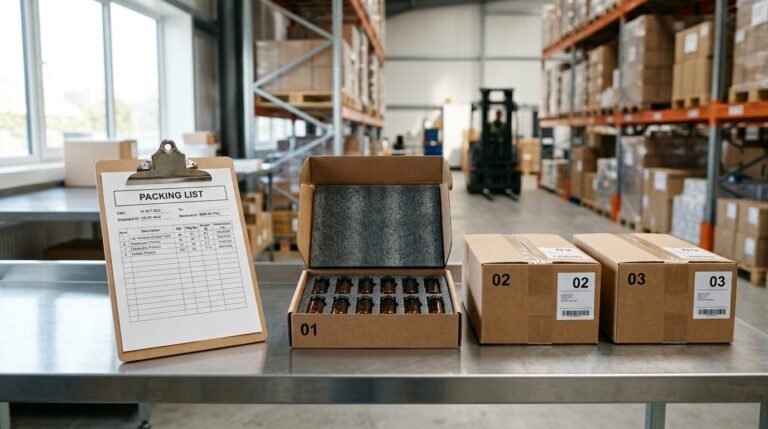
A packing list connects shipment information to the physical arrangement of the goods. For companies importing laboratory supplies, reference standards and other technical products, this connection helps identify what has been shipped and where each item is packed.
A purchase can be commercially accurate and still create difficulties during receiving. Unidentified boxes or discrepancies between the actual contents and the documentation can be enough to cause confusion.
Reviewing the packing list should therefore be part of shipment preparation. Checking it beforehand helps reduce requests for clarification and corrections once the goods are already in transit.
What Is a Packing List?
A packing list is a document that details the contents and distribution of goods across the packages in a shipment.
It includes the contents of each box or pallet, along with weights and measurements. This information supports transportation planning and cargo inspections. Source: International Trade Administration — Packing List.
In practice, it should allow someone to locate a particular product without needing additional explanations from the supplier.
Imagine a shipment containing three boxes and several product codes. Stating only “three boxes of laboratory materials” provides little help during receiving. Linking product codes and quantities to each box number makes the information useful for checking the shipment.
What Is the Difference Between a Packing List and a Commercial Invoice?
These documents serve complementary purposes:
| Document | Main Purpose | Key Information |
|---|---|---|
| Proforma Invoice | Present the proposed terms of the transaction. | Products, prices and proposed commercial terms. |
| Commercial Invoice | Document the international sale. | Goods sold and their values. |
| Packing List | Describe the physical arrangement of the shipment. | Package contents, identification and characteristics. |
A packing list does not replace a commercial invoice. Information shared by both documents must be consistent, particularly product identification and quantities. Source: International Trade Administration — Common Export Documents.
A thorough review connects what was agreed, what was invoiced and what will actually be shipped.
What Information Should You Check on a Packing List?
Typical information includes the parties involved, the invoice reference, product descriptions and quantities, packaging types and counts, identifying marks, weights and dimensions. Source: International Trade Administration — Common Export Documents.
To organize an internal review, follow this sequence:
- Identification: Does the document match the correct supplier and purchase order?
- Products: Do the codes clearly identify each item?
- Quantities: Is the unit clear—for example, vial, box, kit or individual piece?
- Distribution: Can you identify which package contains each product?
- Version: Does the file reflect the final shipment configuration?
The last point deserves particular attention. A document prepared before a packaging change may no longer describe the goods as shipped.
Considerations When Importing Laboratory Supplies
Technical products require careful attention to their descriptions.
Consider a hypothetical example: a laboratory purchases ten vials of a reference standard, each containing 100 mg. The internal review must distinguish the number of vials from the amount contained in each vial. An unclear description can cause confusion between procurement, the supplier and the receiving team.
For this type of purchase, compare the product code and requested pack size against the purchase order records. If batch tracking is required, agree in advance on how that information will be provided.
It is also helpful to identify who will perform the technical review. Procurement can check quantities and commercial references, while laboratory staff verify that the identified material matches the approved specification.
This division of responsibilities helps prevent a generic commercial description from being accepted without review by the people who will use the product.
How Does a Packing List Support Logistics?
Weights, measurements and package contents support freight forwarding and physical inspection. The International Trade Administration identifies the document as a resource for determining weights and freight costs, as well as checking package contents during customs inspections. Source: International Trade Administration — Packing List.
For purchasing teams, this leads to a straightforward practice: obtain the final packaging details before completing shipment planning.
If the supplier changes the number of boxes, the team should check which documents and logistics information need updating. Using different versions across procurement and logistics can trigger unnecessary questions when the shipment needs to move forward.
Pay Attention to Consolidated Shipments
When shipments are consolidated, the documentation must reflect how the goods have been grouped.
As an internal control practice, maintain a clear connection between each purchase order, its products and the final packages. If goods are repacked, the responsible team should be able to trace the relationship between the original packaging and the new arrangement.
For example, if items from two purchase orders are placed in one box, the receiving team should still be able to identify which products belong to each order.
The objective is to preserve the ability to check the goods, even when their physical arrangement changes during logistics preparation.
Is a Packing List Required for Every Import?
It should not be treated as a universal requirement without reviewing the transaction. Documentation requirements depend on the destination country, the product and the shipment itself. Confirm those requirements with the importer and the parties managing the shipment before dispatch. Source: International Trade Administration — Common Export Documents.
In Brazil, for example, the Federal Revenue Service states that a packing list forms part of the customs clearance documentation where applicable and describes situations in which it is not normally issued. That approach should not automatically be applied to other countries. Source: Brazilian Federal Revenue Service — Packing List.
Frequently Asked Questions About Packing Lists
Can a packing list simply be a copy of the purchase order item list?
The purchase order can provide a starting point, but the review must account for what has actually been packed. Partially fulfilled orders require particular attention.
What should you do if you find a discrepancy?
Ask the parties responsible for the document and the packaging to clarify it. Before approving the final version, determine whether the issue is in the file, the physical preparation of the goods or a change to the order.
How can you avoid using outdated documents?
Establish a simple version control process and share the final file with the teams involved. Any subsequent changes should be communicated to the parties managing the shipment.
Include Documentation in Your International Purchasing Plan
A review process before shipment helps coordinate procurement, laboratory staff and logistics. Start by defining who checks each piece of information and when the document will be approved.
CWS Abroad facilitates the direct purchase of international products for companies throughout Latin America. Contact us to discuss your import requirements and the arrangements for your purchase.